16 Nobel Laureates Warn: AI's Shock 'Bigger and Faster Than the Industrial Revolution'
Steam, electricity, and computers each gave society decades to adapt. AI may give us only a few years — so act now. On July 13, 2026, more than 200 economists and AI researchers, among them 16 Nobel economics laureates, issued a joint statement through Stanford University’s Digital Economy Lab titled “We Must Act Now” (Stanford Digital Economy Lab). Signatories include Daron Acemoglu and Simon Johnson, who shared the 2024 Nobel, heavyweight economists like Joseph Stiglitz, Paul Krugman, and Ben Bernanke, and senior executives from OpenAI, Google DeepMind, and Anthropic. The message is blunt — AI could bring an economic transformation surpassing the Industrial Revolution in a far shorter span, so waiting until it’s certain means arriving too late. The real weight of this statement, though, lies not in the force of its warning but in a paradox: even scholars who once doubted AI job-loss fears now speak in one voice — yet the statement leaves the “how” pointedly blank. Below: what the statement says, who signed it, why now, and its ramifications — dissected through the eyes of a historian, a sociologist, and big history.

What the Statement Says — a Three-Sentence Warning
The statement itself is short — a three-sentence open letter titled “We Must Act Now: A Statement on AI’s Transformation of the Economy” (wemustactnow.ai). Its gist: AI may become radically more powerful over the next decade; the result could be an economic transformation larger than the Industrial Revolution but arriving far faster; and so we must act now to build institutions and guardrails.
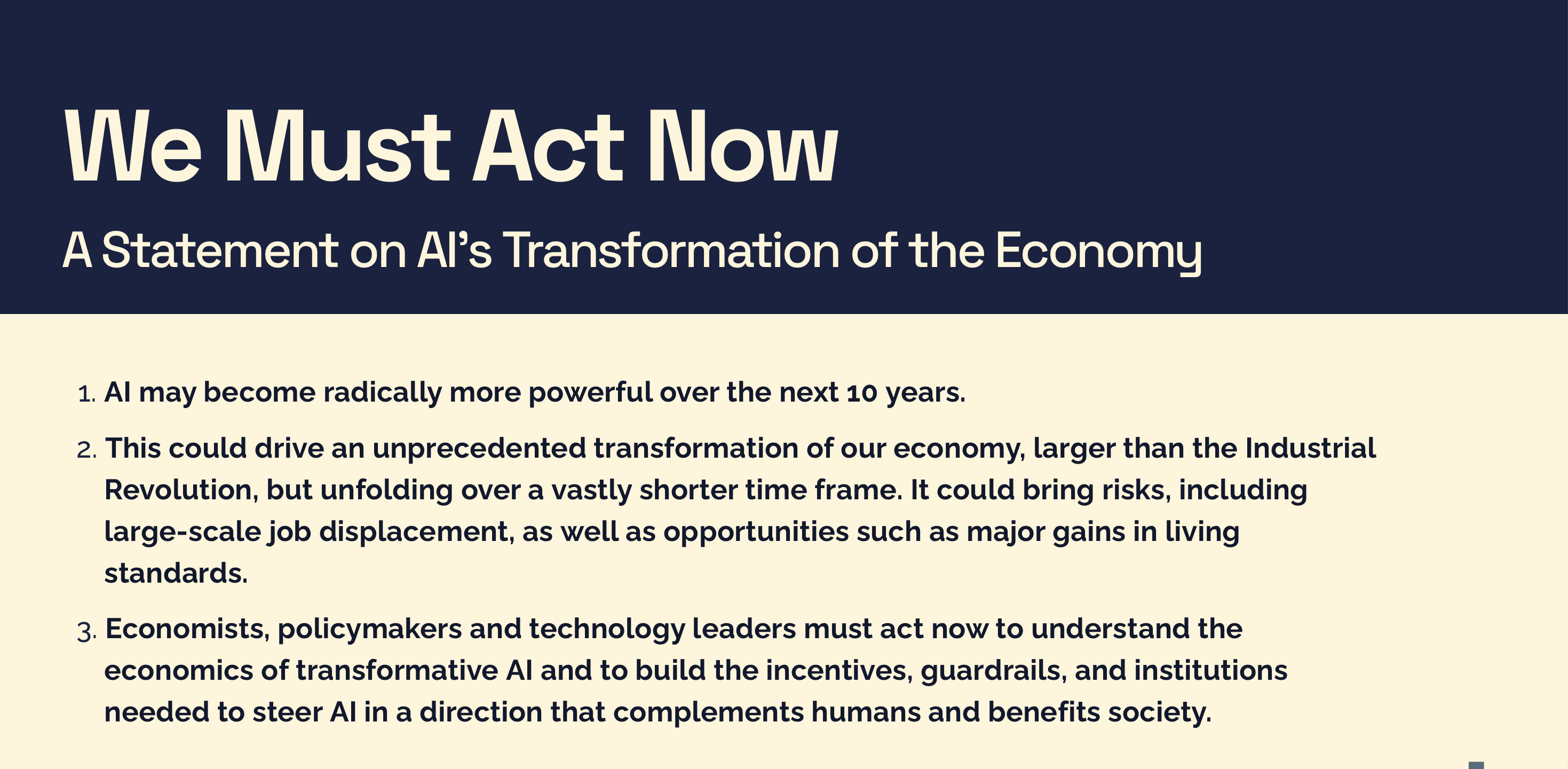 Screenshot of the statement. All three sentences of “We Must Act Now” appear verbatim. Source: wemustactnow.ai
Anton Korinek (University of Virginia, affiliated with Anthropic), one of the organizers, distilled the logic in the launch press release:
“Steam, electricity, and computers each gave societies decades to adapt; AI may give us only a few years. We cannot improvise our strategy and institutions in the middle of the transformation. Waiting for certainty means arriving too late.”
The claim has three layers. First, scale — the transformation AI brings could exceed the Industrial Revolution. Second, speed — it may arrive in a few years, not decades. Third, direction — so we must, starting now, research and build policy and institutions to steer AI to complement rather than replace humans. The organizers include digital-economy and AI-economics researchers Erik Brynjolfsson, Ajay Agrawal, Anton Korinek, and Tom Cunningham.
Who Signed — an Unusual Alliance of Economists and AI Industry
What makes this statement notable is its roster. Sixteen Nobel economics laureates alone signed — names like Michael Spence, Joseph Stiglitz, Paul Krugman, and Ben Bernanke. Especially symbolic are Daron Acemoglu and Simon Johnson. The two MIT professors, who shared the 2024 Nobel, had actually been on the cautious side of “AI causes mass unemployment” alarmism. Their names on a statement urging institutional action now signal that the academic center of gravity has shifted.
More unusual still is that economists and AI companies stood side by side. OpenAI CFO Sarah Friar, Google DeepMind chief scientist Jeff Dean, and Anthropic co-founder Jack Clark — the people actually building AI — jointly urged preparation for the shock of the very technology they make. It’s rare for those who sell the technology and those who analyze its fallout to sign the same document.
Why Now — the Layoffs Have Already Begun
There’s a reason the statement stresses “now”: the warning is present-tense, not future-tense. Per reporting, over 100,000 US workers were laid off due to AI in the first half of 2026 (Edaily). Earlier, Amazon announced roughly 14,000 corporate job cuts in October 2025, citing preparation for AI adoption, and fresh college graduates in particular are hitting a frozen white-collar job market. The UN has warned that AI could widen inequality between nations.
| Item | Detail |
|---|---|
| Released | July 13, 2026 · Stanford Digital Economy Lab |
| Signatories | 200+ economists & AI researchers (incl. 16 Nobel laureates) |
| Core warning | AI’s economic transformation may be bigger and faster than the Industrial Revolution |
| Grounding reality | 100,000+ AI-related US layoffs in H1 2026 |
| Call to action | Deeper research + early policy/institutions; steer AI to complement humans |
Sources: Stanford Digital Economy Lab · Edaily · Al Jazeera (2026-07).
As Korinek noted, the real problem isn’t speed itself but that institutions can’t keep pace with it. If technology leaps exponentially while law, education, and welfare crawl linearly, the widening gap in those few years is the crisis.
 Photo by Freek Wolsink on Pexels
A Historian’s Eye — Is the Industrial Revolution Really a Good Comparison?
The statement leans on the “Industrial Revolution” analogy. A historian would flag two things. One: that transition was anything but smooth. As machines displaced weavers in late-18th/early-19th-century Britain, workers smashed machines in the Luddite movement of 1811–1816 — roughly 1,000 machines destroyed in the first year. Contrary to common belief, they weren’t against machines as such; they resisted the way the technology was introduced — wage cuts, and cheap unskilled labor replacing their jobs. The problem wasn’t technology but its direction and distribution. And while new technology did eventually create more jobs, a full generation endured stagnant wages and hardship before that “eventually” arrived — decades before the fruits reached workers.
Two: that’s why the statement’s “there’s no time this round” carries weight. In Power and Progress (2023), Acemoglu and Johnson argued that the gains of technology don’t spread to everyone automatically — it depends on who sets its direction (power and institutions). The Industrial Revolution’s long pain wasn’t technology’s fault alone but institutions lagging behind. Those very authors signing a statement saying “AI may not even give us time to endure that lag” is a warning that compresses history’s lesson.
A Sociologist’s Eye — the Old Disease of ‘Institutional Lag’
Sociology coined the perfect concept for this a century ago: “cultural lag,” proposed by sociologist William Ogburn in his 1922 book Social Change. Technology (material culture) changes fast, but the law, institutions, and norms (non-material culture) that must absorb it follow slowly — and cracks and social problems open in the gap. The statement’s fear that “institutions can’t keep pace” is precisely Ogburn’s cultural lag threatening to replay in the AI age.
If Ogburn conceptualized institutional lag, Keynes was the first to name the unemployment it causes. In his 1930 essay “Economic Possibilities for our Grandchildren,” he coined “technological unemployment” — “unemployment due to our discovery of means of economising the use of labour outrunning the pace at which we can find new uses for labour” — and forecast it as a new malady we’d hear about often. That century-old diagnosis returns intact as the statement’s “speed” warning.
The sharper sociological point is the target of this shock. Where past automation mainly took aim at factory manual labor, this AI wave hits college-educated white-collar and professional work head-on. In a society where work is identity and social standing, the shaking of “the educated person’s stable job” goes beyond unemployment statistics to a question about the social contract itself. That’s the backdrop to the statement’s repeated invocation of “mass unemployment.”
A Big-History Eye — Is This a Threshold in Human History?
Step back to the scale of human history. Big History, formalized by David Christian and others, reads the story of the cosmos, life, and humanity through a handful of “thresholds.” The agricultural revolution roughly 11,000–12,000 years ago opened population and settlement; the industrial revolution some 250 years ago opened fossil energy and mass production. Big History reads these thresholds as “points where complexity leaps a level,” each sharply expanding the energy and information humanity can wield.
In this frame, AI poses one question — is it a new Industrial-Revolution-scale threshold, or an extension of the information revolution? The signatories effectively bet on “it may be a new threshold.” The insight Big History offers is the compression of time. The gaps between thresholds have kept shrinking — 10,000 years from agriculture to industry, 200 years from industry to information, and now a matter of years. Humanity has always taken generations to digest a great transition; if AI shrinks that to a few years, the problem isn’t the technology but the adaptation speed of human society.
Ramifications and Outlook — and the Limit of ‘No Solution’
So what will this statement change? Two threads. On the positive side, the mood that dismissed AI unemployment as “conspiracy” or “hype” has shifted. A document signed by 16 Nobel laureates alongside AI companies changes the weight of policy debate — lending legitimacy to governments’ discussions of retraining, income safety nets, and taxation.
But there’s a cold limit. The statement says “what,” but leaves “how” blank. It stops at the principle of “do more research and make policy,” without spelling out concretely how to handle mass unemployment (basic income? retraining? AI taxation?). Two hundred scholars agreed on the warning but couldn’t reach the prescription. That’s less incompetence than an honest confession that no one yet knows the answer. There’s an old irony here — even Keynes, warning of technological unemployment in 1930, stayed optimistic that it was a “temporary phase of maladjustment” and left the prescription blank. A century on, the warning has grown far sharper and faster, yet the one constant is that humanity is still clumsy at advancing the answer to “so what do we do?”
So What — the Weight of the Warning, and Our Homework
The most important sentence in this statement isn’t the warning but the premise beneath it — “waiting for certainty means arriving too late.” Past technological shocks could be handled after the fact. Once the Luddites’ anger passed, labor law and education systems followed. But that late response worked only because change was slow. If AI erases that buffer, humanity’s age-old method of “clean up after the shock” simply won’t work. That’s why the statement demands the unfamiliar posture of preparing.
Korea is no bystander. In a country with a high share of white-collar and professional work, where new-graduate hiring is already freezing, “cultural lag” could arrive faster. The blank the statement left — retraining, safety nets, an industrial policy that steers AI to complement people — is what each society must fill for itself. That is the real homework 200 scholars left. The warning has already sounded. What remains is how we spend those “few years.”
Frequently Asked Questions (AI Shock Statement)
Q1. What exactly is this statement? It’s the “We Must Act Now” joint statement released July 13, 2026 by Stanford University’s Digital Economy Lab. Over 200 economists and AI researchers (including 16 Nobel economics laureates) signed it, arguing that AI could bring an economic transformation bigger and faster than the Industrial Revolution, so we must prepare now.
Q2. Who signed it? Sixteen Nobel laureates (Daron Acemoglu, Simon Johnson, Joseph Stiglitz, Paul Krugman, Ben Bernanke, Michael Spence, and others) signed alongside senior AI-company executives from OpenAI, Google DeepMind, and Anthropic — an unusual lineup of economists and the AI industry side by side.
Q3. Why does it stress “now”? Because steam, electricity, and computers gave society decades to adapt while AI may give only a few years, so institutions can’t keep pace. Over 100,000 AI-related US layoffs already occurred in the first half of 2026.
Q4. What are the statement’s limits? It agreed on the warning but offered no concrete solutions (basic income, retraining, AI taxation, etc.). It stopped at the principle of “do research and make policy,” without spelling out how to handle mass unemployment.
This article is a general explainer based on information public as of July 2026 and is not advice recommending any specific security or product investment decision.
댓글
✍️ 편집자 모드 — 이 댓글은 공개되지 않고 편집자에게만 전달됩니다.