z.ai GLM Guide — Run Claude Code at Half the Cost
Whenever developers talk about “bang-for-the-buck AI” lately, one name keeps coming up: z.ai. Run by China’s Zhipu AI (智谱AI), its GLM models get attention for a simple reason — you can get comparable performance at one-third to one-fifth the price of Claude or GPT. And there’s one use case that hits especially close to home for this blog’s readers: wiring z.ai into Claude Code so you keep the tool you already know, but slash the token bill by more than half. This piece covers why z.ai is called the value champion, how to actually use it (from web chat to the API to the Claude Code integration), its pricing, real use cases, and the limits you must know.
⚠️ Prices and model names are as of mid-2026 and z.ai changes them often (a rock-bottom promo actually ended in February 2026). Always check the official pricing page before adopting it. Also, z.ai is a Chinese company’s service — for sensitive-data decisions, see the “Limits & Caveats” section near the end.
What z.ai Actually Is — The Source of the Value
z.ai is the global service brand of Zhipu AI, a company that spun out of Tsinghua University circles. It offers its own GLM (General Language Model) series through a web chat (chat.z.ai), an API, and coding-tool integrations. GLM’s breakout moment was GLM-4.6, released in September 2025. Reviews said “Claude Sonnet–class coding at a much lower price,” the “value” label stuck, and the lineup quickly expanded to GLM-5, 5.1, 5.2, and the lightweight GLM-4.7.
As of mid-2026, z.ai’s headline model lineup looks roughly like this.
| Model | Role | Notes |
|---|---|---|
| GLM-5.2 | Flagship | Main model for coding/agents. Default in web chat and the coding plan |
| GLM-5-Turbo | Speed-first | Prioritizes response speed, good for high volume |
| GLM-4.7 | Light workhorse | Cheap but usable quality (a Haiku-tier substitute) |
| GLM-4.7-Flash / GLM-4.5-Flash | Free | Free just for signing up, ~203K-token context |
The very existence of a free Flash tier is the symbol of z.ai’s value strategy: let people try it for free, then convert them to paid once they’re satisfied with the quality.
The key is that the free tier isn’t a toy — it gives a real-use-grade 200K-token context. That’s where z.ai’s value story begins.

Price Comparison — Just How Cheap Is It?
Saying “it’s cheap” doesn’t land, so let’s use numbers. Comparing API token prices (USD per 1M tokens) across representative models:
| Model | Input (1M tokens) | Output (1M tokens) |
|---|---|---|
| GLM-5.2 (z.ai) | $1.40 | $4.40 |
| GLM-4.7-FlashX (z.ai’s cheapest paid) | $0.07 | $0.40 |
| GLM-4.7-Flash / 4.5-Flash | Free | Free |
| Claude Sonnet 4.6 (reference) | $3.00 | $15.00 |
Source: z.ai official pricing docs; token prices as of mid-2026.
Run the same work on GLM-5.2 and input is about 2.1× cheaper, output about 3.4× cheaper. Since output tokens usually dominate LLM cost, output being 3×+ cheaper shows up loudly on the actual bill. Here’s the output price of representative models, visualized.
For a real-world feel: on a “coding agent” workload calling 1,000 times a day (assume 5K input / 20K output tokens per call), some analyses put the monthly token cost of a premium model at about 4.5× that of the GLM tier. The bigger the scale, the more that multiple turns straight into a billing gap.
Usage 1 — Try It Right Now in the Web Chat
The easiest start is chat.z.ai. With no install, you can use a GLM-5.2-based chatbot and agent right in the browser, and this is where you try the free Flash models mentioned above.
- Go to
chat.z.ai→ sign up with email/social (free) - Ask questions or request code right in the chat → even the free tier has a 200K-token-class context, so you can paste long docs and code
- Switch between GLM-5.2 (main), Turbo, and Flash from the model selector at the top
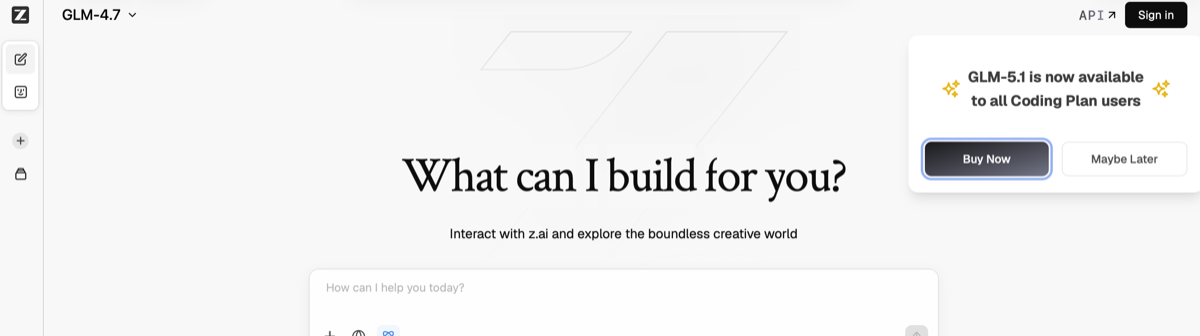 The actual z.ai web chat (chat.z.ai). You can use GLM models straight from the browser with no install, switching models at the top. (Captured directly, 2026-07)
The web chat is enough to “see the performance with your own eyes.” But z.ai’s real value comes from the API and tool integrations.
Usage 2 — Connect It to the API and Claude Code (the key part)
z.ai’s decisive strength is that it offers an Anthropic-compatible endpoint. In plain terms, if you reroute the requests Claude Code normally sends to the Claude API over to z.ai’s servers, the tool stays Claude Code but the actual inference is handled by GLM. You change nothing in your familiar workflow and only cut the cost.
Setup takes just an API key plus a few environment variables in ~/.claude/settings.json.
- Get an API key: create one on the z.ai API key management page
- Edit
~/.claude/settings.json— add anenvblock like this.
{
  "env": {
    "ANTHROPIC_AUTH_TOKEN": "your_z.ai_API_key",
    "ANTHROPIC_BASE_URL": "https://api.z.ai/api/anthropic",
    "ANTHROPIC_DEFAULT_HAIKU_MODEL": "glm-4.7",
    "ANTHROPIC_DEFAULT_SONNET_MODEL": "glm-5.2",
    "ANTHROPIC_DEFAULT_OPUS_MODEL": "glm-5.2",
    "API_TIMEOUT_MS": "3000000"
  }
}- Run
claudein a new terminal → Claude Code’s requests are now handled by GLM.
The gist is: change ANTHROPIC_BASE_URL to https://api.z.ai/api/anthropic to route requests to z.ai, and map GLM models onto the Haiku/Sonnet/Opus slots. If editing the file yourself feels risky, z.ai’s helper can configure it automatically.
npx @z_ai/coding-helperThis command auto-detects your coding tools, connects the GLM coding plan, and sets things up. If your Claude Code is stale, run claude update first to be safe.

The GLM Coding Plan — Use It on a Flat Subscription
If pay-per-token feels risky, or you code every day, the GLM Coding Plan (flat subscription) is a better fit — a monthly plan that lets you use GLM near-unlimited for coding workloads. As of mid-2026 there are roughly three tiers.
| Tier | Approx. monthly | For | Notes |
|---|---|---|---|
| Lite | ~$10/mo | Hobby / beginner | Billed quarterly |
| Pro | ~$30/mo | Active developers | Higher quota |
| Max | ~$80/mo | Heavy users | Top quota, priority support |
Billed quarterly; as of Q2 2026 there were discounted quarterly prices of about $27 / $81 / $216. The rock-bottom $3/mo promo ended in February 2026. Check the z.ai subscription page for current rates.
Here’s the point to grasp: compared with Claude/GPT coding subscriptions that typically run $20–$200 a month, the GLM Coding Plan starts at the Lite tier for around $10 a month. If your goal is “enough performance at minimal cost” rather than “the absolute best,” the barrier to entry drops sharply.
Real Use Cases — Where It Pays Off
z.ai shines most on work that’s “small performance gap, large volume.”
- Always-on coding agents: hook GLM into tools like Claude Code, Cline, or Roo to run repetitive, high-volume coding — refactoring, test generation, boilerplate — at low cost. GLM-5.1 has ranked near the top of open-source coding leaderboards (SWE-Bench Pro 58.4), so for everyday coding there’s little to miss.
- Bulk text processing / translation: batch jobs with heavy call volume, like translating thousands of product descriptions, summarizing reviews, or classifying documents. With output 3×+ cheaper, the total-cost difference is dramatic.
- Backend LLM for RAG / internal tools: put GLM as the inference engine of internal pipelines that never face users directly (search summarization, auto-tagging), and quality feels similar while operating costs drop.
- Prototyping / learning: validate ideas fast on the free Flash models, then upgrade to a paid tier if it looks promising.
Conversely, for the hardest reasoning and precise architecture design — where a 1% quality difference decides the outcome — a top premium model still has the edge. Claude Sonnet 4.6, for instance, posts 79.6% on SWE-bench Verified, keeping its lead in high-difficulty territory. The point is to split models by the nature of the task: premium for heavy design, GLM for repetitive bulk work — you capture both performance and cost.
Limits & Caveats — Don’t Skip These
Good value doesn’t automatically mean it’s the answer. Weigh these coldly before adopting.
- Data & privacy: z.ai is a Chinese company’s service. Sending code/documents through the API means they’re processed on those servers. For work involving company secrets, personal data, or undisclosed business info, review the data-handling policy and your internal security rules first, and keep sensitive data out. Start with publicly shareable code and general text.
- Residual performance gap: benchmark averages are close, but on the very hardest reasoning and agent reliability (SWE-Bench Verified, Terminal-Bench, etc.) top premium models still lead on some metrics. “Nearly the same” isn’t “exactly the same.”
- Price/policy volatility: as seen, rock-bottom promos end and pricing gets reshuffled often. “Cheap now” isn’t guaranteed to stay cheap, so don’t hang your cost case on one specific promo.
- Regulatory / continuity risk: cross-border AI regulation and service-access changes are worth factoring in for any long-term dependence.
So What — Who Should Use z.ai
In short, z.ai (GLM) is the best pick for anyone who needs “good-enough performance at minimal cost, especially at scale.” It comes down to three questions.
- Is the work repetitive / high-volume? → Then GLM’s 3×+ cheaper output is straight profit.
- Is top-tier quality decisive? → Then use premium only for the heavy parts and split the rest to GLM.
- Is the data sensitive? → Exclude sensitive info and start with work that’s safe to share.
The most practical starting point is this article’s core case — connect z.ai to Claude Code and cut the cost in half with the exact same workflow. Verify the performance on free Flash first, and if you’re happy, add the ~$10/mo Lite tier. The “best value” reputation isn’t marketing — it comes from a number: a 3× gap in output pricing.
※ This is a usage guide based on public information and official docs, not a recommendation to pay for any particular service. Prices, models, and policies change often, so verify current values on the official pages before adopting, and judge sensitive-data handling by your organization’s security rules.
References
- z.ai official pricing docs (Pricing Overview)
- z.ai — official Claude Code integration guide
- GLM Coding Plan pricing breakdown (2026)
- GLM-4.6 vs Claude Sonnet performance & cost analysis
댓글
✍️ 편집자 모드 — 이 댓글은 공개되지 않고 편집자에게만 전달됩니다.